
adams@phys.lsu.edu (225) 578-6847
Miscellaneous Topics
Areas of Interest
For some years now we have been investigating a variety of model low dimensional systems that can provide insights into complex correlation effects that are known to be important in many condensed matter systems of current interest. In particular, we have investigated the quantum properties of helium films, non-degenerate electrons on cryogenic hydrogen surfaces, thin film BCS superconductivity in high magnetic fields, and the metal-insulator transition in ultra-thin homogeneously disordered "metal" films. In each of these areas the goal has been to isolate the salient characteristics of what is an ostensibly well-controlled system with the ultimate goal of gaining a deeper understanding of quantum correlation effects in more widely studied materials.
Current Project
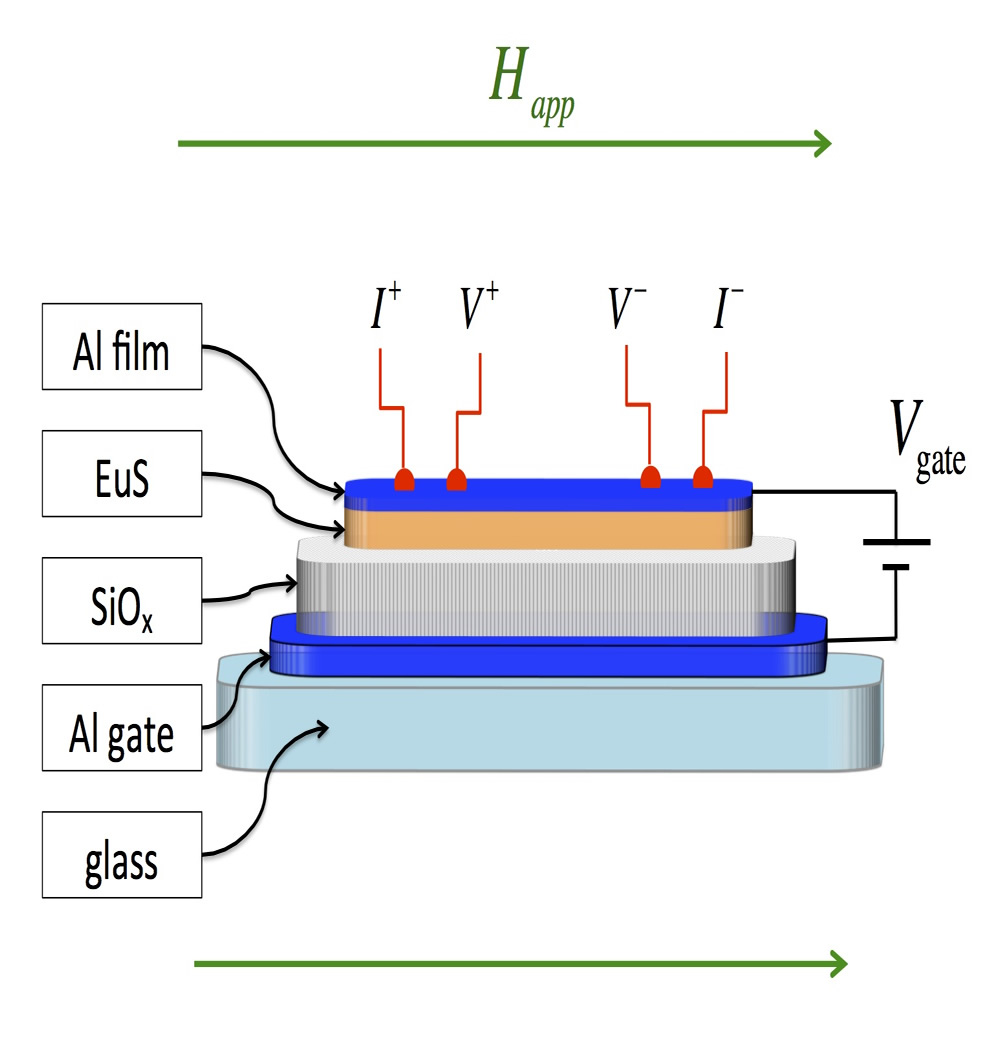
We are investigating the interface-mediated exchange field induced in Al films that are deposited on the ferromagnetic insulator EuS, see left figure. Much of the work in the last 10 years on superconducting-ferromagnetic bilayers has been focused on the superconducting order parameter that is induced in the FM side of the interface. We, however, are interested in the nature of the exchange field that is concurrently induced on the SC side. We use spin-resolved tunneling to directly probe the exchange field in the Al layer. Recently, we have employed a gating scheme, as shown in the figure on the left, to apply an electric field to the superconductor-ferromagnet interface. We demonstrated that this electric field actually modulates the strength of the exchange field by a few percent. Our ultimate goal is use this as the basis of a superconducting switch or field-effect superconducting transistor.(read more...)